
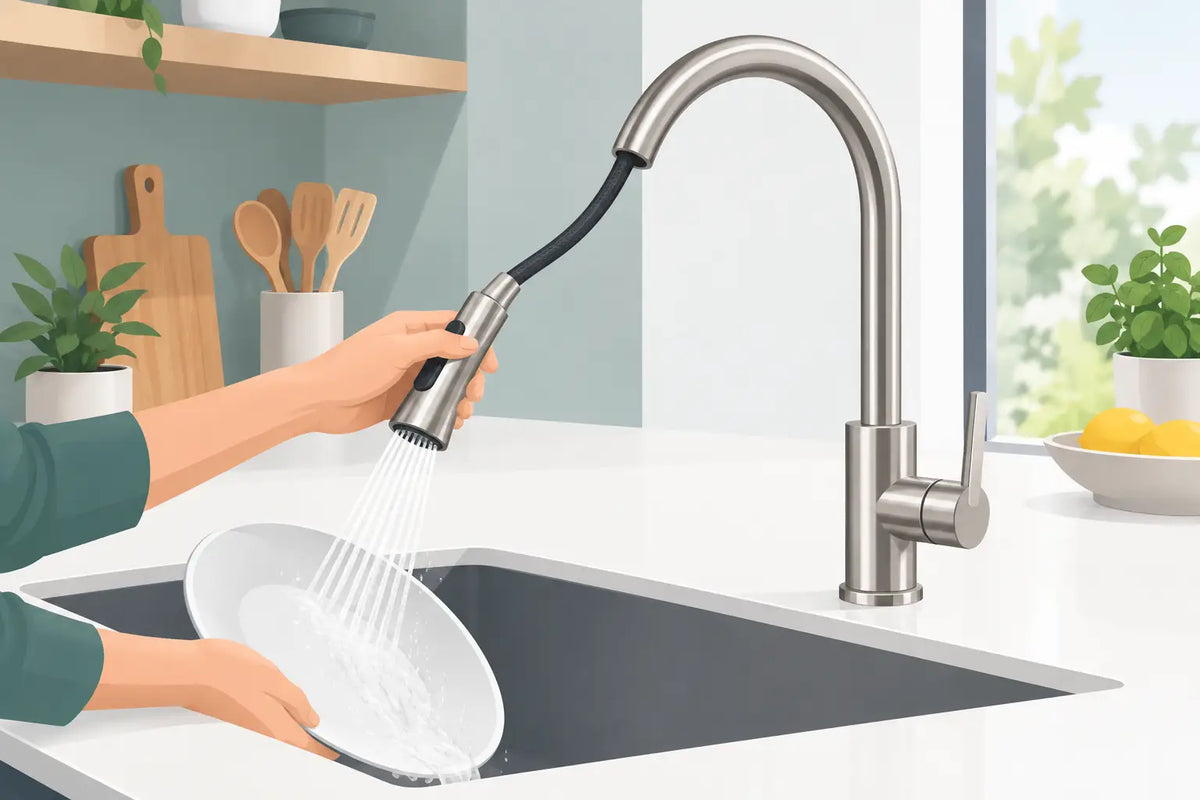
Rinsing a large stockpot, washing vegetables or cleaning a double-bowl sink: it’s in these repeated tasks that a pull-down kitchen faucet proves its worth. More mobile than a fixed spout, it directs water where it’s needed and makes the sink area more efficient without sacrificing the kitchen’s appearance.
This type of faucet is suitable for both a complete renovation and replacing an aging faucet. But the right choice depends on more than just color or price. Spout height, sink size, cartridge quality, spray mode and countertop compatibility directly affect ease of use and the installation’s lifespan.
Why choose a pull-down kitchen faucet?
The integrated spray head lets you pull the hose out of the spout to reach the corners of the sink, fill a container on the counter or rinse away food scraps before doing the dishes. Once released, it retracts into the spout using a counterweight or magnetic docking system, depending on the model.
L’The benefit is tangible in busy kitchens. The concentrated spray helps remove stuck-on food from dishes and baking sheets, while the steady spray is better for filling and everyday washing. Whether you have a deep single-bowl or double-bowl sink, this mobility means you don’t have to maneuver heavy items under a stream that’s hard to direct.
The main trade-off is maintenance and installation. A hose, spray head and retraction mechanism add a few components compared with a fixed faucet. However, a well-designed model with reliable fittings and a quality cartridge reduces this risk and keeps the faucet working smoothly for years.
The criteria that really make a difference
Spout height and reach
A high-arc spout provides plenty of clearance for stockpots, large pans and baking sheets. It also creates a more contemporary silhouette, especially on an island. But its height needs to be proportionate to the sink and the space beneath the cabinets. In a kitchen with a low window or closely spaced upper cabinets, an oversized faucet can become a problem before installation even begins.
The spout reach is just as important. L’eau should fall near the center of the basin or slightly toward the back, without hitting the wall and splashing onto the countertop. For a double sink, make sure the spray head can easily reach each basin. The faucet dimensions should always be assessed alongside those of the sink, rather than on their own.
Spray type and controls
Most models offer a regular stream and a spray stream, often controlled by a button on the spray head. The spray stream is useful for quick rinsing, while the regular stream helps limit splashing when filling a glass or saucepan.
A single handle is generally the simplest choice for everyday use. It adjusts the temperature and flow with one hand, a welcome advantage when cooking. Some faucets automatically keep the last spray mode selected, while others return to the regular stream as soon as the water is turned off. There’s no universally better system: choose one that suits your habits.
Spray-head retraction
A spray head that doesn’t fit properly into the spout quickly loses its appeal. Counterweight systems work well when there’s enough clear space under the sink. The weight attached to the hose must be able to move without hitting the pipes, the trap, the garbage disposal, or items stored in the cabinet.
Magnetic systems hold the spray head more securely when it’s put back in place. They’re especially useful for families who use the faucet often and want the spout to line up perfectly. In either case, check the hose’s flexibility and usable pull-out length, not just its advertised length.
Materials and the cartridge
The finish catches the eye, but the internal construction determines reliability. A metal body and a ceramic cartridge are good indicators of durable residential faucets. The cartridge controls the flow and temperature. When it’s high quality, the handle stays precise and the risk of premature leaks is reduced.
The warranty is also worth reading before making a purchase, especially for functional components. At Voda, lifetime-guaranteed cartridges offer useful peace of mind for a part that gets used every day. For a renovation project, this protection can carry more weight in the decision than a simple decorative detail.
Which finish should you choose for your kitchen?
Chrome remains a reliable choice. Bright, versatile, and easy to coordinate, it suits both modern kitchens and more classic decor. However, it shows water spots and fingerprints more easily, especially in a busy household.
Matte black creates a crisp contrast against a white sink, light countertop, or kitchen with clean graphic lines. It pairs well with black handles, light fixtures, and metal accessories. Its visual presence is strong: it’s best to include a few coordinating accents in the room to keep the overall look cohesive.
L’stainless steel or brushed nickel offer a softer option, especially popular for hiding signs of use. These finishes blend naturally with stainless steel appliances and kitchens in warm tones. They require less daily wiping to look clean than highly polished chrome.
The best finish is one that complements the metals already in the kitchen without requiring everything to match. Mixing two finishes can work, as long as the choice is intentional. For example, a matte black faucet can pair very well with brushed brass handles if both elements have a clear presence in the decor.
Check compatibility before ordering
Before choosing a pull-down kitchen faucet, measure the number of holes in the sink or countertop, their diameter, and the space available behind the basin. Many single-handle faucets fit a standard opening, but an existing sink may have two, three, or four holes. A deck plate can sometimes cover unused holes, provided it is compatible with the chosen model.
Also measure the countertop thickness and check for access beneath the sink. Thick countertops, undermount sinks, and installations near a window require more careful verification. If the faucet is installed on an island, consider the overall look: a very tall spout becomes an architectural feature and should fit the kitchen’s proportions.
L’The water supply must be shut off before installation. The connections should be tightened according to the manufacturer’s recommendations, without forcing the parts. After installation, run the water for a few minutes, test both spray modes, and pull the spray head out several times to make sure the hose moves freely. If access is difficult or the plumbing is old, having a plumber do the work can prevent unpleasant surprises.
Maintenance: keeping the spray precise and the finish impeccable
Simple maintenance protects both the appearance and the function. Wipe the faucet with a soft cloth after significant splashes, especially if your water is high in minerals. Avoid abrasive powders, rough scouring pads, and harsh cleaners: they can dull or mark some finishes.
If the spray becomes irregular, the spray head’s small openings may be affected by limescale. Gently rub the soft nozzles with your finger or follow the maintenance method recommended for the model. A drop in pressure isn’t always a faucet defect: it may be caused by deposits in the aerator, the spray head, or the water supply.
Keep the space under the sink clear around the hose. Cleaning products, storage bins, and flexible pipes should never prevent the counterweight from moving. This small detail makes a big difference to how well the spray head retracts.
Making a durable choice that suits your habits
A pull-down kitchen faucet is a functional investment that makes a difference at every meal, rinse, and cleanup. For a family kitchen, choose a spray head that’s easy to grip, a flexible hose, and a finish that’s easy to maintain. For a minimalist kitchen or a central island, spout height and finish quality will matter more.
Take the time to compare the dimensions, the retraction system, the materials and the warranty before making your decision. A model that is well-proportioned for your sink and designed for everyday use turns an ordinary task into lasting comfort.
