
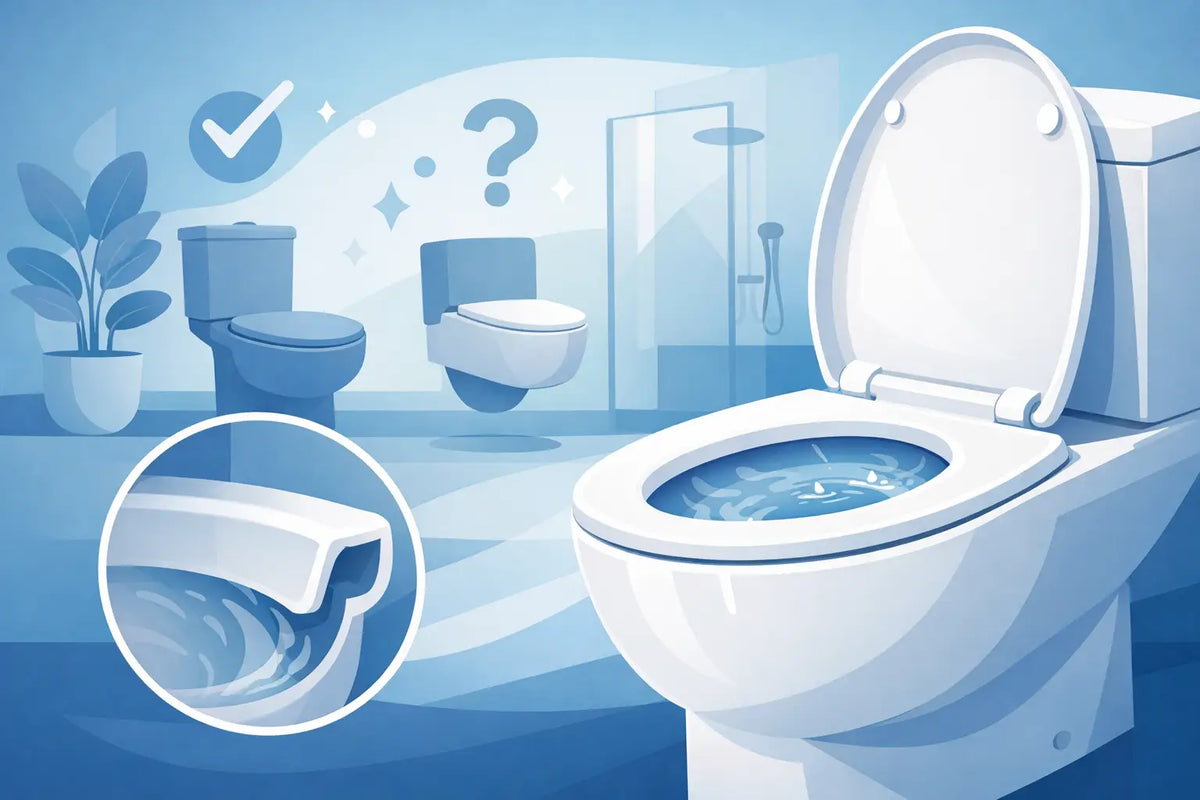
The term rimless toilet reviews often comes up when renovating a bathroom, and for good reason: this type of toilet promises easier cleaning and a neater appearance. But when it comes to ease of maintenance, flush quality, and budget, not all models are created equal. A well-chosen rimless toilet can genuinely improve everyday comfort. Conversely, a poorly designed model may cause splashing or provide a less effective flush.
What is a rimless toilet?
In a traditional toilet bowl, water circulates beneath an inner rim before spreading throughout the bowl. This area is barely visible, difficult to reach with a brush, and can retain deposits, limescale, and bacteria.
A rimless toilet, also called a WC rimless, removes this enclosed rim. Water is directed through an open system, often a flushing lip or side channels, to wash the walls in a more accessible way. The principle is simple: fewer hidden recesses means fewer areas that are difficult to clean.
This design detail does not turn a toilet into a maintenance-free fixture. The bowl still needs to be cleaned regularly, especially in regions with hard water. However, cleaning is faster and the result is easier to check visually.
Rimless toilet reviews: the real advantages
The first advantage is hygiene. Without an inner rim, dirt has fewer places to accumulate. During cleaning, it is possible to see the entire surface of the bowl and use a brush or sponge without having to work under an inaccessible area. For a family bathroom or a frequently used toilet, this practical benefit is significant.
Maintenance is also more pleasant. Deposits that form beneath the rim of a traditional toilet can become difficult to remove over time. On a rimless bowl, the surface is generally more open. Combined with high-quality glazed ceramic, this helps limit the adhesion of everyday dirt.
Design is another strong point. Rimless toilets fit naturally into contemporary bathrooms, particularly with a wall-hung bowl, a minimalist flush plate, and furniture with clean lines. They are also available as floor-mounted models, which are practical when you want to modernize the room without changing the entire installation.
Finally, many recent models are designed to operate with a controlled flush. Good water circulation can clean the bowl effectively without requiring an excessive volume. However, it is important to look at the actual flushing performance rather than relying solely on the rimless label.
Limitations to know before buying
A rimless toilet is not automatically better in every situation. The flushing design is essential. In high-quality models, water is distributed evenly and remains well contained within the bowl. In a less refined or poorly adjusted product, it may miss certain areas or cause slight splashing.
The price may also be somewhat higher than that of an entry-level toilet with a rim. This difference is due to the design of the bowl and the water distribution system. It is often justified for a long-lasting renovation project, but it should remain consistent with your priorities: ceramic quality, flushing mechanism, seat, and ease of installation matter just as much.
You should also avoid thinking that an open bowl eliminates the need for cleaning products. Limescale, water marks, and bacteria are still present in every bathroom. The difference is that the areas to clean are more accessible, not that they disappear.
The flush makes all the difference
Beyond the absence of a rim, pay attention to the path taken by the water. An effective flush should wash the front, sides, and back of the bowl, with sufficiently controlled flow to prevent splashing. Manufacturers use different solutions: side jets, a widened rear opening, or visible peripheral distribution.
Before choosing, review the available technical information and, if possible, observe the model in a store. A well-designed bowl has a regular interior, without difficult-to-reach angles, and a water outlet that appears sturdy and well finished. The quality of the tank or carrier-frame mechanism is just as important, since consistent flushing also depends on reliable components.
For wall-hung toilets, check that the carrier frame, flush plate, and replacement parts are easy to identify. For a floor-mounted model, make sure it is compatible with your existing drain and with the space available behind the bowl. An excellent toilet on paper cannot compensate for an unsuitable installation.
How to choose a rimless toilet suited to your project
The right choice depends less on a trend than on how the room will be used. In a guest toilet, a compact and easy-to-clean model may be the priority. In a primary bathroom, seating comfort, flush noise, and overall style deserve more attention.
Take the time to compare four elements before ordering: installation type, dimensions, flush quality, and seat finish. These criteria directly affect your satisfaction after installation.
Wall-hung toilet or floor-mounted toilet?
A wall-hung toilet frees up floor space and gives the room a lighter appearance. It also makes cleaning beneath the bowl easier. On the other hand, it requires a suitable carrier frame and more extensive wall preparation. It is a popular option for complete renovations or contemporary-style bathrooms.
A floor-mounted toilet remains a reliable solution and is often easier to install as a replacement for existing equipment. It is particularly suitable when you want to keep the plumbing in place and control the renovation budget. Modern rimless models now offer very refined lines, with an integrated tank or a more compact silhouette.
Dimensions and comfort of use
Measure the available depth, the distance from the walls, and the drain location precisely. An oversized toilet can obstruct movement, even in a well-designed bathroom. In a narrow room, a compact bowl can sometimes provide more comfort than a larger model.
Seat height also deserves your attention, particularly for tall people, families, or occupants seeking greater everyday comfort. Check the bowl dimensions with and without the seat, as product specifications may list different measurements depending on the included components.
Seat, ceramic, and useful details
A soft-close seat improves comfort by preventing slamming. A quick-release system makes it easier to remove the seat to clean the hinges and the back of the bowl. These are small details, but they simplify long-term maintenance.
For the ceramic, choose a smooth, even finish that is easy to wipe clean. High-quality glazing contributes to the toilet’s neat appearance as well as its resistance to common stains. For a cohesive project, pair the toilet with finishes that echo the lines of your vanity, faucets, or accessories.
Who are rimless toilets a good choice for?
They are particularly suitable for homeowners who want to reduce the time spent cleaning without compromising on style. They are also a good option for families, well-maintained rental properties, and projects where the bathroom needs to maintain a neat appearance between cleanings.
For a very tight budget, a good-quality traditional toilet may still be a reasonable choice. A reliable traditional model with a solid mechanism is preferable to a rimless toilet with an insufficient flush. The best purchase is one that combines a compatible installation, a well-designed bowl, and easy-to-maintain parts.
At Voda, choosing a toilet means considering your entire layout: available space, desired style, installation type, and everyday use. Take measurements before finalizing your selection, then choose a rimless model whose flush and finish inspire confidence. This practical approach will help your bathroom stay beautiful and pleasant, day after day.
