
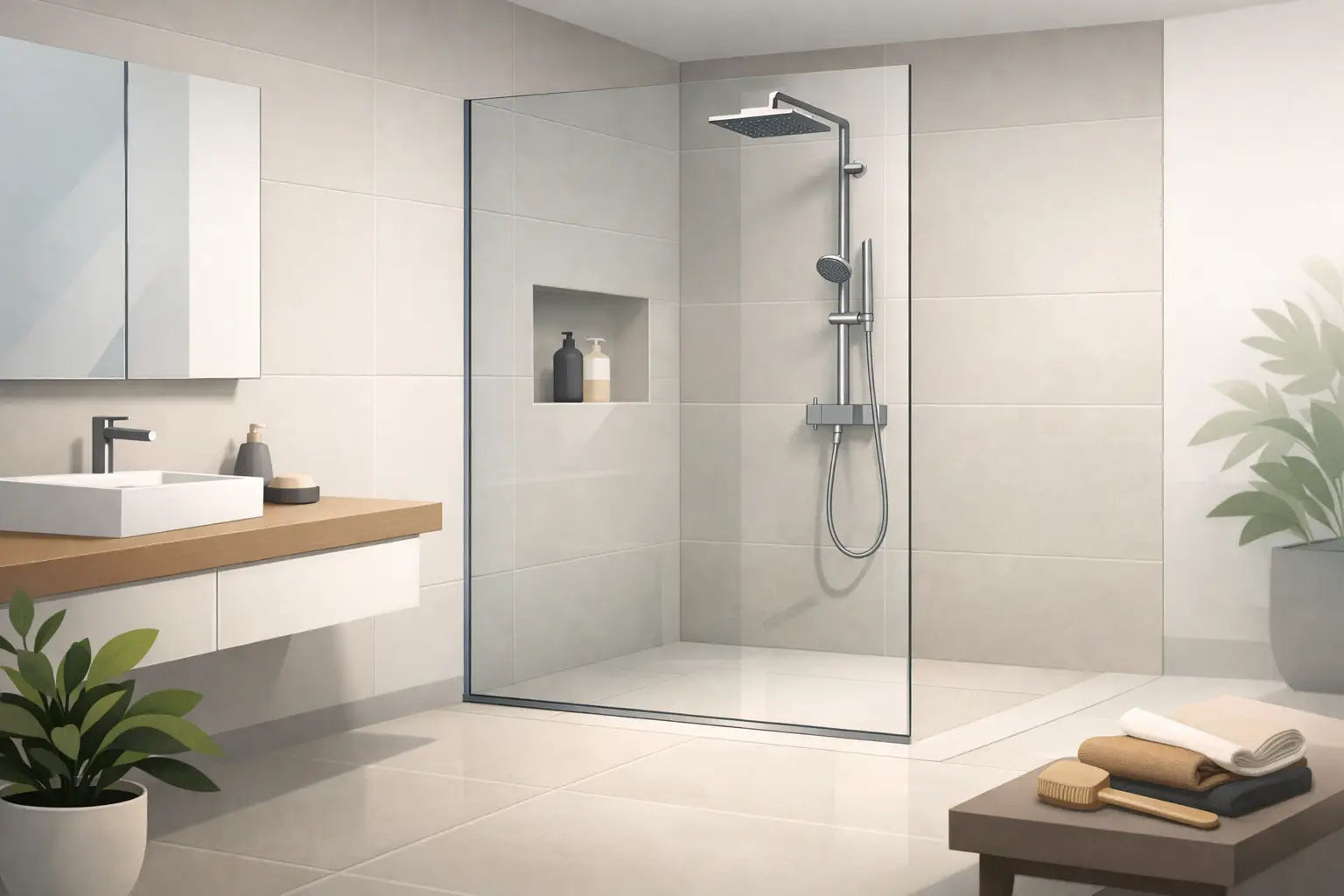
When a bathroom needs to appear larger, cleaner, and simpler for daily living, the threshold-free Italian shower quickly becomes an obvious choice. It’s not just an aesthetic choice. It’s also a practical solution for entering and exiting without obstacles, facilitating maintenance, and adding real value to the layout.
The highlight is the visual continuity between the bathroom floor and the shower area. Nothing breaks the line. Nothing weighs down the space. In a contemporary renovation, this effect is significant, especially in compact rooms where every detail influences the perception of volume.
Why the threshold-free Italian shower is so popular
A shower that is flush with the floor immediately gives an impression of modernity. The result is more high-end, but it doesn’t require a huge bathroom. On the contrary, it works very well in standard formats, provided that the dimensions and slope are well thought out.
The other advantage is the comfort of use. For a family, for a couple renovating their home for the long term, or for a project where accessibility already matters, the absence of a curb really changes the experience. Movement is easier, the risk of tripping is reduced, and fluidity is gained.
There’s also a maintenance aspect. Fewer visible joints, fewer corners, fewer elements that retain water or soap residue. This doesn’t mean zero cleaning, of course, but cleaning is often simpler than with a more traditional shower made up of several level breaks.
What to check before buying
A successful threshold-free Italian shower relies on the balance between design and technique. This is where some projects become complicated. The concept seems simple, but the quality of the result depends heavily on preparation.
The drainage slope
The floor must effectively guide water toward the drain. If the slope is insufficient, water stagnates. If it is poorly distributed, it can exit the shower area. That’s why the choice of the base, the ready-to-tile receiver, or the drainage system must be consistent with the room's configuration.
A large, very open surface often requires more attention than a closed shower with a door. The more generous the opening, the more one must consider the water trajectory, the power of the shower column, and the position of the drain.
The type of drain
The linear drain is popular for its discreet and contemporary look. It also simplifies some layouts of large format tiles. The central drain remains a reliable and often more economical option. The right choice mainly depends on the desired style, the base format, and installation constraints.
In a new project, the possibilities are broader. In renovations, one must consider the existing structure, the height available in the floor, and the plumbing location. This point often determines whether the project will be simple or more technical.
Waterproofing
This is a topic not to be underestimated. A beautiful shower that is poorly waterproofed quickly becomes a bad decision. Membrane, joints, connections, and finishing around the drain must be impeccable. In this type of installation, durability does not only rely on the appearance of the materials but on the quality that is invisible behind the finish.
The flooring
The matte, mineral, or stone-effect look is highly sought after, but the important criterion remains adhesion. A flush shower must remain pleasant and safe, even with wet feet. Non-slip tiles or a textured base often make a real difference in use.
What configuration to choose for a threshold-free Italian shower
There is no single right formula. The right choice depends on the room, the budget, and the desired level of openness.
The version with a fixed glass panel is probably the most popular. It maintains the clean spirit of the threshold-free Italian shower while limiting splashes. It’s an excellent compromise between design and daily use.
The completely open version appeals with its architectural effect. Visually, it’s very striking. Practically, it requires more space and a more rigorous design. In a small bathroom, it can work, but only if the plumbing, passage width, and jet orientation are well managed.
A configuration with a shower door is also compatible with threshold-free access. It’s a reassuring choice for those who want to maintain floor fluidity while containing more water and heat. It’s no less modern; it’s simply more framed.
The right dimensions to avoid regrets
A threshold-free Italian shower that is too small quickly loses its appeal. The space must allow for free movement without splashing the entire bathroom. In most residential projects, a generous format provides better comfort, especially if the shower is partially open.
One must also consider the clearances around it. The entrance must remain intuitive, without visual obstacles or tight circulation in front of the vanity or toilet. A beautiful shower may seem perfect on paper but can become less pleasant if the entire room is not well balanced.
For professionals as well as individuals, the logic remains the same: it’s better to have a simple and well-proportioned layout than a spectacular effect that is difficult to live with daily.
The materials that make a difference
Clear glass remains a safe bet. It lets in light, lightens the overall look, and highlights the wall covering. A treatment that limits marks is a real plus for reducing regular maintenance.
On the hardware side, matte black, chrome, and brushed gold finishes dominate contemporary projects. The choice is not only about color. One must also consider the durability of the finish, its consistency with the plumbing fixtures, and the ease of replacing or matching components over time.
For the walls, large tiles have the advantage of reducing joints and enhancing the high-end effect. Wall panels can also be very relevant. They speed up installation, simplify maintenance, and offer a clean look that is highly appreciated in renovations where efficiency is as important as style.
How much to budget for this type of project
The price of a threshold-free Italian shower varies according to the base, glass panels, plumbing fixtures, covering, and especially the complexity of installation. The product itself is only part of the budget. In renovations, adjusting plumbing, leveling the floor, and waterproofing can weigh heavily.
This is precisely why a well-structured purchase saves time and avoids indirect costs. Choosing compatible, durable, and easy-to-coordinate components reduces surprises. For a homeowner, this secures the project. For a contractor, it simplifies installation and limits returns to the job site.
At a specialist like Voda, the interest lies in being able to bring together in the same project the shower base, walls, door or panel, shower column, and accessories, with a coherent style and clear quality criteria.
Who really benefits from a threshold-free Italian shower
It suits those who want a more current, accessible, and easy-to-maintain bathroom. It’s a particularly relevant solution in a master suite, a resale-oriented renovation, or a project where future needs are anticipated without sacrificing design.
However, it’s not automatic in all cases. If the existing structure leaves little room to integrate the slope, if the budget is very tight, or if the room is difficult to waterproof properly, a quality standard shower base can sometimes offer a better simplicity-result ratio.
The right choice is therefore not only aesthetic. It relies on three very concrete questions: is it technically feasible, comfortable for daily use, and consistent with the overall budget of the project? When the answer is yes on all three fronts, the threshold-free Italian shower provides real quality of use, with a clean look that endures better than one might think.
If you’re still hesitating, think about your bathroom in five or ten years. The right product is not just the one that looks good today; it’s the one that remains simple, reliable, and pleasant every morning.
