
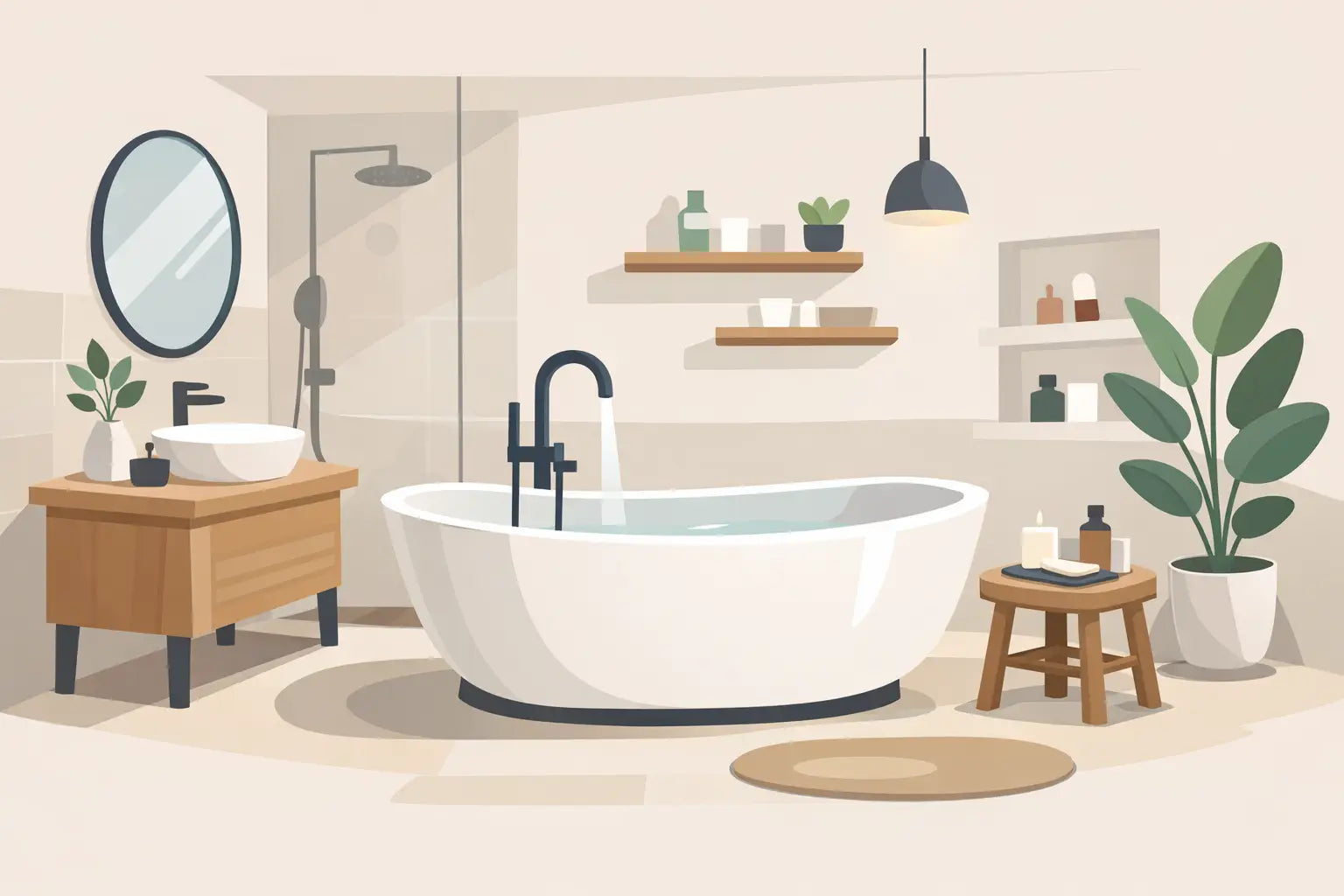
A small bathroom does not preclude comfort. A freestanding bathtub in a small bathroom can work very well if the dimensions, circulation, and connections are considered from the start. The real challenge is not just fitting the bathtub in, but preserving a pleasant living space that is easy to clean and coherent with the rest of the layout.
The choice is therefore less a question of dreams than a question of proportions. A freestanding bathtub brings a strong visual presence, a more upscale style, and a better-defined sense of space than one might imagine. However, in a small room, every centimeter counts. Precision is key.
Why choose a freestanding bathtub for a small bathroom
The freestanding bathtub first attracts with its design. It visually lightens the room, especially if the model rests on a discreet base or a slightly elevated bottom that reveals the floor. In a compact bathroom, this effect is valuable. It gives a more contemporary and less massive impression than a masonry surround or an overly imposing apron.
The other advantage is flexibility. A freestanding bathtub in a small bathroom does not necessarily have to be placed in the center. It can be positioned against a wall, near a corner, or in a tighter composition with a compact vanity and a well-placed toilet. This type of installation allows for maintaining the desired aesthetic without sacrificing functionality.
However, one must be realistic about the compromises. A freestanding bathtub generally requires a bit more attention regarding cleaning around the tub and the installation of the faucet. If the space is really very limited, an alcove bathtub may sometimes be the most effective choice. The freestanding option becomes interesting when one wants to gain style without losing comfort of use.
The dimensions to consider above all
In small bathrooms, the first reflex is often to look only at the length. This is a classic mistake. The width, height, wall thickness, and the bulk of the faucet have just as much impact on the final result.
For a compact space, shorter formats are generally the most relevant. A bathtub around 130 to 150 cm can be suitable depending on the configuration. Below that, comfort may decrease for taller users. Above that, integration becomes more demanding. Width also matters. A narrower model helps clear the passage, but it should not create a feeling of a cramped tub.
Height deserves real attention, especially in a household with children or for daily use. A bathtub that is too high is more difficult to step over. A well-designed tub offers a good interior volume without creating an uncomfortable entry. This is where the interior shape makes a difference. Two models of the same exterior dimension can offer very different sensations.
Where to place the bathtub to avoid blocking the room
A successful small bathroom relies on circulation. One should be able to open the door, access the vanity, use the toilet, and move around without a constant feeling of obstruction. The bathtub should not become the element that disrupts the entire balance.
Placement against a wall is often the smartest choice. It maintains the freestanding effect while freeing up more space in the center. In some cases, positioning near a corner even allows for integrating a wall-mounted faucet and simplifying the visual cleaning of the room.
The center of the room, often seen in larger bathrooms, rarely works in a compact format. It looks spectacular in photos, but is less convincing when space is limited. In a small area, it is better to seek a clear, rational, and elegant layout rather than a decorative effect that hinders daily use.
What shape to favor in a small bathroom
Not all freestanding models occupy space in the same way. Oval shapes are often the softest visually. They facilitate circulation around the bathtub and soften the room. They fit well with a contemporary style and remain easy to pair with minimalist faucets, simple vanities, and current finishes.
More rectangular shapes can be interesting if one wants to optimize a placement against a wall. They create a more architectural reading and often make better use of the room's lines. Conversely, they can seem more visually present if the dimensions are not perfectly adapted.
The sloped back, useful depth, and symmetry also affect comfort. For a main bathroom used regularly, it is better to prioritize a tub that is pleasant to use rather than one chosen solely for its silhouette.
Materials, finish, and sense of quality
In a small space, perceived quality is immediate. One quickly notices if the bathtub seems light, if the finish is average, or if the white lacks uniformity. Conversely, a well-made tub immediately gives a more refined appearance.
Reinforced acrylic remains a relevant choice for many residential projects. It offers a good balance between price, durability, maintenance, and thermal comfort. The surface is pleasant to the touch, the temperature rise is more comfortable than with colder materials, and the weight is generally compatible with most common renovations.
The quality of manufacturing also matters in terms of stability, visible thickness, stain resistance, and ease of maintenance. In a compact bathroom, one is close to every detail. A durable and well-finished product gives a cleaner, sharper, and more upscale impression over time.
Faucets and connections - the detail that changes everything
One often thinks of the bathtub before considering the faucet. However, in a small bathroom, the faucet can complicate or simplify the whole setup. A floor-mounted faucet creates a real visual impact, but it requires the necessary space around the tub and precise planning of the water supply.
Wall-mounted faucets are often more logical in tight configurations. They free up floor space, lighten the installation, and reduce visual bulk. They work particularly well with a bathtub placed near a wall. It is a clean, modern solution that is very suitable for small volumes.
It is also necessary to plan for access to the drain, compatibility of connections, and the exact position of the drain. A beautiful project can lose a lot in simplicity if these elements are addressed too late. When in doubt, it is better to choose a clear, durable, and easy-to-maintain configuration.
How to visually enlarge the space around the freestanding bathtub in a small bathroom
The right model is not enough. The immediate environment plays a major role. A small bathroom appears larger when the volumes are coherent and the materials do not create too many visual breaks.
Large-format tiles, light colors, a discreet shower wall if the configuration is mixed, and a wall-mounted sink can greatly enhance the perception of space. The mirror and lighting contribute to the same effect. Well-distributed light highlights the bathtub without overwhelming the room.
It is also important to avoid accumulating massive elements. If the bathtub is the standout piece, the rest of the furniture should remain understated. A simple composition inspires more comfort than an overloaded bathroom where every object seeks to attract attention.
For whom is this choice really relevant
The freestanding bathtub in a small bathroom is very suitable for homeowners who want to modernize their space without falling into an overly demonstrative renovation. It also meets projects where one seeks real visual value within a controlled budget, provided that a coherent format and reliable finishes are selected.
For a professional, it is an interesting solution in residential renovations where contemporary aesthetics matter in the client's final decision. For an individual, it is often a smart compromise purchase between pleasure, design, and daily use. At a specialist like Voda, the interest is precisely to compare models designed for current interiors, with a reassuring level of finish and clear characteristics.
Before buying, one should ask the right questions. Who will use the bathtub most often? What is the actual circulation in the room? Will the faucet be floor-mounted or wall-mounted? And above all, are we looking for a decorative effect or true comfort for regular bathing? The right answer rarely depends on a single criterion.
A successful small bathroom does not try to do everything. It makes the right choices, in the right format, with durable and well-integrated products. If the freestanding bathtub is chosen with this logic, it can become the best feature of the bathroom, not the one regretted after installation.
