
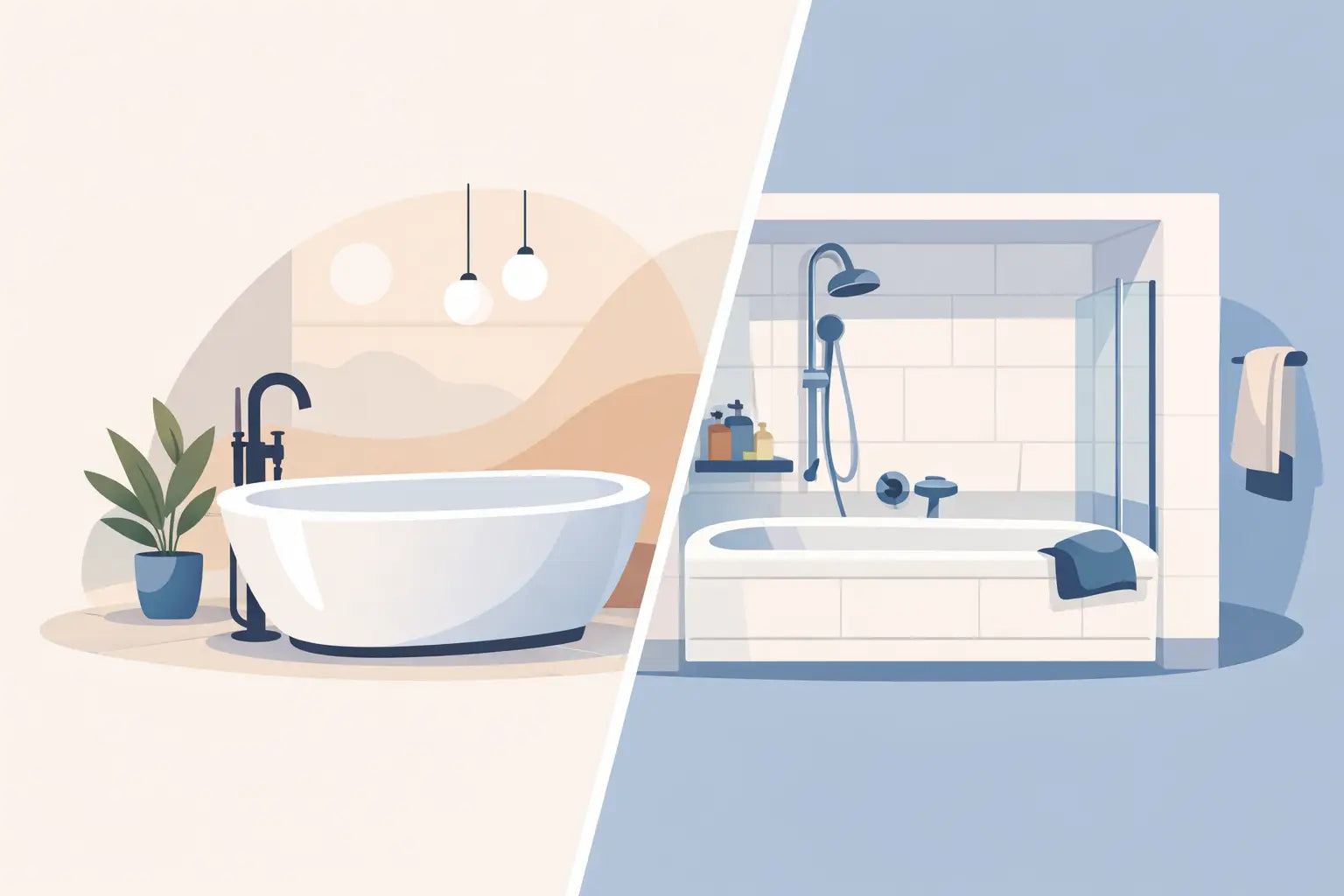
Are you hesitating between a freestanding bathtub or an alcove because both options look appealing on paper? This is often where the real choice begins. In photos, a freestanding bathtub immediately impresses. In a real bathroom, with dimensions to respect, plumbing to plan, and a budget to adhere to, the alcove often scores points.
The right model is not the one that catches the eye the most, but the one that integrates seamlessly into your space without unnecessary compromises. If you are renovating for the long term, it’s better to compare aesthetics, footprint, usability, and overall cost, not just the displayed price.
Freestanding bathtub or alcove: the real difference
A freestanding bathtub is designed to be visible. It is placed away from the walls or with enough clearance to showcase its silhouette. It’s a strong visual choice, often associated with contemporary, open, and well-designed bathrooms.
The alcove bathtub, on the other hand, is installed between three walls. Its format is more architectural, more integrated, and generally easier to plan in a standard renovation. It can accommodate a skirt, wall tiles, or a bath-shower combination depending on the household's needs.
So, it’s not just a question of style. It’s also about available space, circulation, plumbing, ease of maintenance, and daily usage priorities.
If style comes first
Aesthetically, the freestanding option has a head start. It immediately gives a high-end effect, appearing lighter visually, with a sculptural presence that transforms the room. If you want the bathtub to be the focal point of the bathroom, it’s often the right choice.
But this effect works best when the room has space to breathe. In a compact bathroom, a freestanding tub may seem ambitious on paper, then feel bulky once installed. The eye is drawn to it, but circulation around it can become tight. The result then loses some of its elegance.
The alcove offers a more discreet style, but not at all outdated. With straight lines, neat cladding, and well-chosen fixtures, it can very well support a modern bathroom. It is particularly suitable for projects where a clean, cohesive, and efficient look is desired without sacrificing usable space.
If space is your main constraint
This is often where the choice is made. A freestanding bathtub requires more than just floor space. You need to allow for visual and practical clearance around the bath; otherwise, its appeal diminishes. Even if its dimensions seem comparable to those of an alcove, its installation is more demanding.
The alcove optimizes small and medium bathrooms much better. It utilizes existing walls, frees up circulation, and facilitates the organization of the rest of the room. For a family bathroom, a condo, or a renovation where every centimeter counts, this is a very concrete advantage.
If you have a secondary bathroom or a tighter space, the alcove often remains the most logical solution. Conversely, in a larger main room, the freestanding option makes perfect sense and can truly enhance the layout.
The case of the bath-shower
If you need a bath that also serves as a shower, the alcove has a clear advantage. It easily adapts to a wall, curtain, or door, with simpler splash management and waterproofing.
A freestanding tub can sometimes be combined with a shower, but the project becomes more specialized and often less practical for daily use. For a family with children or for frequent use, it’s better to be honest about this: the alcove generally meets the reality of usage better.
Purchase budget and overall cost
A freestanding bathtub is not just a product purchase. It often entails a broader budget. The tub itself may cost more, but you also need to consider the fixtures, drain placement, plumbing adjustments, and, in some cases, more complex labor.
The alcove is usually more accessible in terms of entry cost and more predictable in installation. This is a strong point for renovations with tight budgets or for rental projects where a good level of finish is sought without multiplying hidden costs.
You should also think about the relationship between investment and usage. A freestanding tub brings a high perceived value. It can enhance the look of the room and create a more premium effect. But if you install it in a space that’s too small or if it complicates maintenance, this extra budget may seem less justified over time.
Installation: simple on paper, variable on site
The installation of an alcove is often easier to anticipate because it follows a logic well-known to installers. The walls frame the location, the connections are more standard, and it integrates easily into a classic renovation.
The freestanding option requires more attention. The positioning must be just right, especially if the fixtures are on the floor or offset. The drain must be in the right place, and the floor must be ready to accommodate a bathtub that will be seen from all angles. The slightest misalignment is immediately noticeable.
For professionals, this type of tub is not a problem in itself. But for the client, it means one simple thing: you need to validate the configuration before purchase. This avoids unpleasant surprises once the project begins.
Maintenance and daily cleaning
We often think about style, rarely about cleaning. Yet, it’s a real criterion. A freestanding bathtub generally requires a bit more access around it to properly clean the floor and visible surfaces. Depending on the chosen model, dust and splashes can accumulate in less accessible areas.
The alcove, on the other hand, often cleans more quickly because it is framed by walls. There is less perimeter to maintain, less exposed surface, and a simpler logic if the bath is combined with a shower.
This doesn’t mean that a freestanding tub is difficult to live with. It simply suits those who want a more signature look and are willing to put in a bit more attention to maintenance.
Comfort, depth, and user experience
Comfort depends less on the type of bathtub than on the model itself, but certain trends emerge. Many freestanding tubs focus on a more enveloping immersion and a crafted shape for relaxation. They are often chosen for that moment of pause that one wants to be more comfortable, calmer, and more rewarding.
The alcove often prioritizes versatility. It is easy to enter, works well for shared use, and meets a more intensive family routine. If the bathroom needs to serve everyone, every day, this versatility matters more than a simple spa effect.
The right reflex is to check the usable interior length, the slope of the backrest, and the height of the rim. A beautiful bathtub that seems deep may turn out to be less comfortable than expected if its proportions do not match your usage.
Which option best enhances your bathroom?
If your goal is to create a visually striking space, the freestanding option has a strong enhancement power. It catches the eye, modernizes the whole, and gives an impression of superior finish. In a well-thought-out main bathroom, it’s a choice that can clearly make a difference.
If your priority is an efficient, durable space that aligns with daily use, the alcove retains excellent value. It doesn’t seek to steal the spotlight, but it does the job very well. And when it is well integrated, it gives an impression of mastery and functionality that reassures both in use and resale.
At a specialized retailer like Voda, the interest is precisely to compare contemporary models in both categories, with dimensions, materials, and finishes designed for concrete residential projects.
How to decide between a freestanding bathtub or an alcove
Ask yourself three simple questions. Does your bathroom have enough space to showcase the tub? Do you want a spectacular room first or an ultra-practical one? And does your budget also cover installation, not just the tub itself?
If you answer space, design, and staging, the freestanding option is probably the best path. If you answer optimization, bath-shower, and controlled budget, the alcove often imposes itself naturally.
The right choice is not the one that follows the trend, but the one you will still appreciate after years of use. A successful bathroom is one that remains beautiful without becoming complicated to live with.
